

If you searched for What Brandon Thinks because you want a second look at a long chat, start with the messages behind a finding—not the verdict at the top. The service at whatbrandonthinks.org turns a supported WhatsApp or iMessage export into a structured report. Important observations are paired with short excerpts and confidence labels so you can compare the interpretation with the conversation you chose to upload.
That structure makes a report easier to inspect. It does not make an interpretation a fact about somebody’s private intent. This guide walks through the report, shows how to check an example, and explains what context an exported chat may leave out. You can also read a complete fictional sample report, check the product review and limits, or start with a free preview.
If you are ready to look at your own conversation, open the report workspace or return to the What Brandon Thinks homepage.
What a What Brandon Thinks report is
What Brandon Thinks is a chat-analysis service for supported message exports. It is not an account connection that reads your inbox in the background. You choose a conversation file, confirm who the participants are, and select the kind of report you want. The product reads the submitted transcript and organizes patterns into a verdict, scorecard and findings. The sample report shows the full format without asking you to upload a real conversation.
The word “report” matters. The result is an interpretation of the material in a particular export. It can help you notice that one person repeatedly restarts a plan, that a group has a recurring role, or that a conversation changed around a certain exchange. It cannot see what happened in the room, hear a voice note that is absent from the file, or ask the other person what they meant.
The practical test is traceability: can you find the messages the report points to, and do those messages support the narrower observation being made? If you want to see the product’s stated workflow, supported formats and tradeoffs in one place, use the What Brandon Thinks review. If you want to inspect a full example, open the fictional sample report.

Illustration: a report section should lead you back to the source messages it discusses.
Read the original messages before accepting a summary
A verdict compresses a much longer conversation. Compression is useful when you have been rereading hundreds of messages, but every summary leaves out detail. A report may describe a pattern accurately while missing a joke, an earlier agreement, a quiet practical contribution or a relevant event that never appeared in the export.
Read the report’s short version once, then open the evidence for one specific claim. Ask what the excerpt literally says before asking what it might mean. The distinction is small but useful. “They postponed the plan twice” is an observation about events in the transcript. “They do not care about me” is a conclusion about a private feeling. The first may be checked against messages. The second needs more than a transcript.
Try writing the distinction in two lines:
What happened: The time was not confirmed in two planning exchanges.
What I think it means: They may not want to meet.
The first line is something both people could verify. The second is one possible reading. It may be right, wrong or incomplete. Keeping them separate lets you use the report without handing it authority over your own judgment.
Follow each finding back to its evidence
An evidence excerpt is a starting point, not the whole case. Read the message before it and the reply after it. Check the date and the participants. If the same claim appears across several parts of the chat, compare those examples rather than relying on the most vivid one. If the excerpt is technically present but the surrounding exchange changes its meaning, trust the fuller context.
For example, “I’ll see” can be a soft refusal, a genuine request for time, or a response to a question that the other person could not answer yet. The same words can carry different meanings in different conversations. A useful report gives you a place to look; you still decide whether the reading fits what you know.
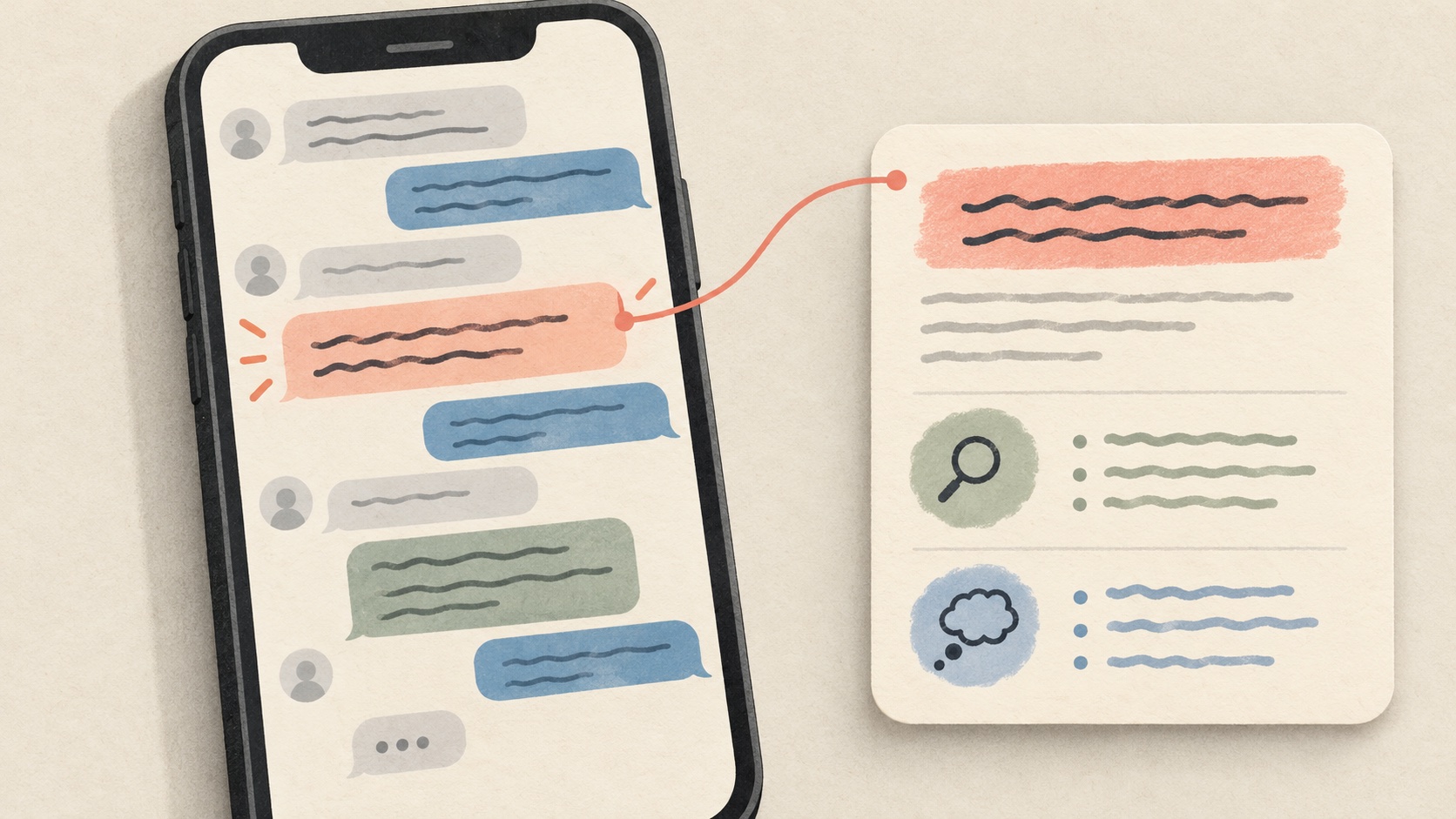
Illustration: the highlighted line is easier to assess when the surrounding thread remains in view.
Use a simple check before you treat a finding as useful:
Claim: One person carries the planning.
Evidence to inspect: Who proposes dates, confirms details and follows up?
Context to restore: Did the other person complete a practical task elsewhere?
Question still open: Is this a recurring pattern or a short busy stretch?
This check helps you notice a common mistake: counting messages as if volume were the same as effort. A person can write less and still book the table, arrange the ride or close the loop. Conversely, a large number of friendly replies may keep a conversation active without resolving the original plan. Look at the action the conversation needed, not just the number of bubbles on screen.
Use confidence labels as a reading cue
Confidence labels describe how strongly a finding is supported by the conversation available to the report. Read them as a signal about how carefully to check a section. A higher label does not mean “this is certainly what the other person thinks.” A lower label does not automatically make the observation useless; it may tell you that the file contains limited or mixed evidence.
The difference is between support and truth. Several clear examples can support the statement that plans are often left unconfirmed. They still do not prove why that happens. The other person may be busy, avoid making plans, assume someone else will decide, or have context that does not appear in the chat. A confidence label cannot choose among those explanations by itself.
Think of the label as a reading order: check the tentative claim with extra care; inspect the evidence for a stronger one too. Never convert a label into a probability, diagnosis or promise about a future response. The product’s safety and privacy page describes the distinction between verified excerpts and interpretations, along with the limits of the service.
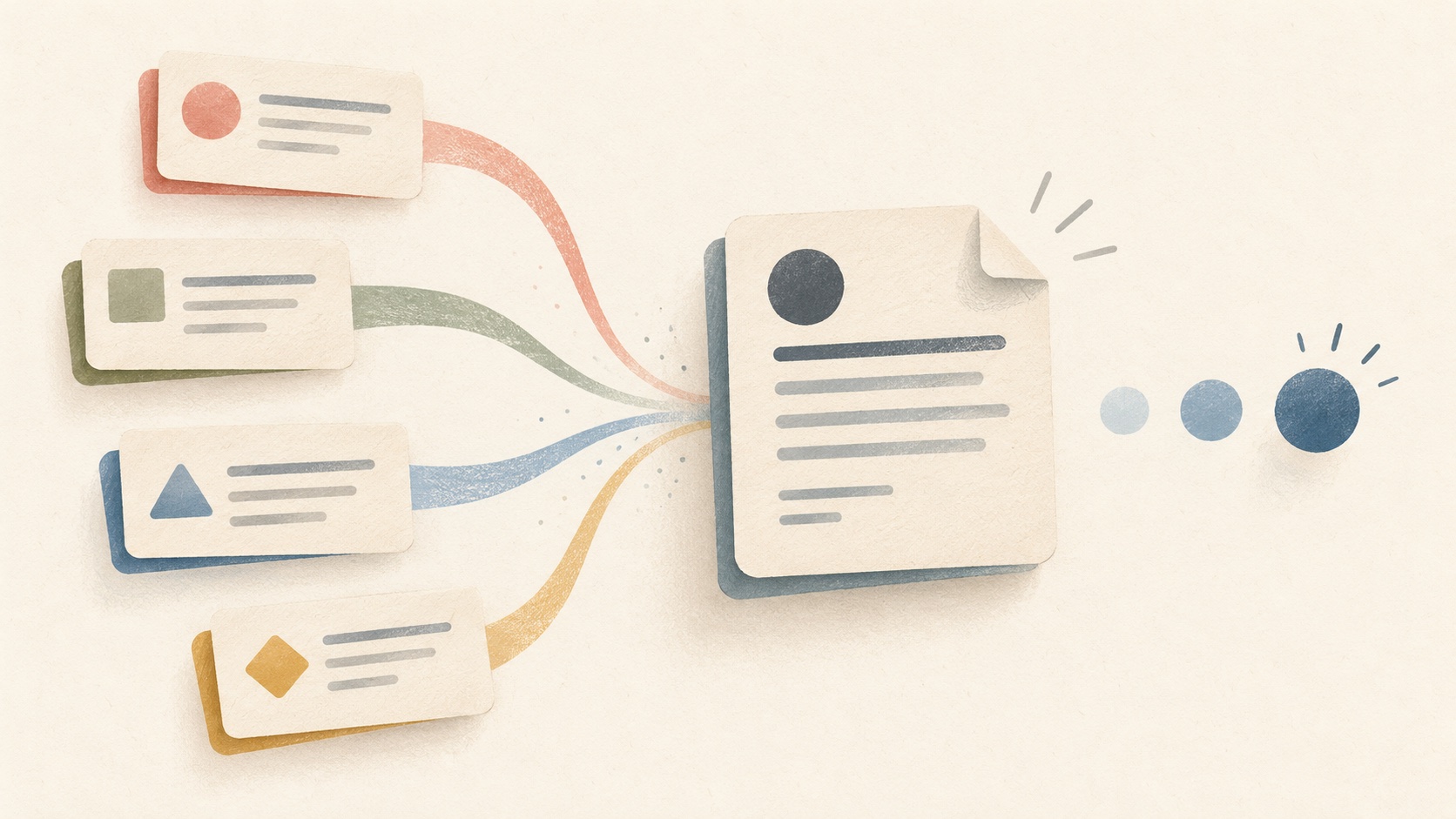
Illustration: confidence is about the evidence available for a finding, not certainty about a person.
Transcript: Start with one finding. Open the messages behind it. Treat confidence as a cue to review the evidence, not as certainty.
Walk through a fictional finding
Imagine a made-up exchange in which two friends are trying to choose a day for dinner. This is an invented example, not a customer transcript or a result generated by the product:
Mara: Are we still trying for dinner this week?
Dev: Yes, I would like that. I am waiting on my schedule.
Mara: No rush. Let me know when you know.
Dev: Thursday opened up. Want me to book something near you?
A careful observation might be: “The plan became concrete after Dev had a schedule.” That statement is supported by the order of messages. A broader claim such as “Dev avoids commitment” would need repeated examples and still should be presented as an interpretation rather than a fact.
One way to check the reasoning is to separate four parts:
Observed sequence: The plan remained open while the schedule was unknown.
Supporting line: “I am waiting on my schedule.”
Counterevidence: Dev later suggested a booking and a location.
Possible next step: Ask whether a specific day makes planning easier.
The counterevidence matters. If a report notices that Mara initiated the plan, that does not erase Dev’s later follow-through. If it notices the delay, that does not prove lack of interest. The most useful reading can hold both facts at once: one person opened the conversation, and the other moved it forward when a concrete time became available.
Look for a pattern across the thread
A single exchange can explain a moment; a pattern can help you decide whether the moment repeats. When a report summarizes recurring behavior, look for examples across different dates and situations. Are you seeing the same interaction each time, or are several unrelated details being grouped under one label? Did the pattern change after someone made a clear request? Is there a counterexample that changes the summary?
Use the shortest representative period that still answers the question. A complete archive is not automatically a better archive. A very long export may include years of unrelated plans, names and personal details. A narrow, relevant range is easier to check and exposes less information. For a relationship-focused question, the relationship chat guide explains how to think about a recurring pattern without treating it as proof of hidden intent. For friend or group dynamics, see the friends guide or family chat guide.
If the pattern you are trying to understand starts with an indirect written complaint, our passive-aggressive letters guide shows how to separate the words on the page from assumptions about the writer’s motive.
Evaluate the free preview before unlocking a report
The free preview lets you judge your own result before checkout. The current product page says the preview includes a verdict, five personal scores and two findings with the messages behind them; no card is required for that preview. The free preview page explains what is included and what stays locked. You can also compare the format against the fictional full sample before uploading anything.
Do not ask only whether the writing sounds confident. Ask whether it is specific to your conversation, whether the excerpt supports the finding, whether it acknowledges a reasonable counter-reading, and whether the suggested next step is proportionate. If a line feels wrong, inspect the messages before deciding whether the report or your first impression has the better context.
You can stop if the preview does not help. A paid tier gives you more of the report, not guaranteed certainty. Check the current pricing page and final checkout screen for the price and terms shown to you; prices may be displayed in different currencies.
What a chat report cannot prove
A transcript records selected written messages. It does not contain every conversation, facial expression, pause, private thought or offline event. People also use shorthand, punctuation, emojis and inside jokes differently. A message that feels cold to one reader may be neutral to its writer. A delay can have many causes, only some of which appear in the thread.
The research does not support a blanket rule that text messages are usually misunderstood. In five controlled email experiments, Justin Kruger, Nicholas Epley, Jason Parker and Zhi-Wen Ng found that senders could overestimate how well readers would recognize intended sarcasm. A 2025 study by Monique Pollmann and Carla Roos compared the intended and received emotional tone of everyday messages between friends and work or education emails; sender and receiver ratings aligned well in those samples. That finding challenges the popular assumption that online messages are routinely read more negatively than intended.
Another experiment by Serena Petrocchi and colleagues used a fictional WhatsApp exchange with 160 young adults. It found that message valence and emoji use affected perceived social presence. That study measured the experience of an interaction, not whether someone’s private intent could be proven from a transcript. Each study asked a different question, used a bounded sample and says nothing about What Brandon Thinks’ accuracy. Together they support a narrower approach: context matters, written messages can communicate well, and an individual report finding still needs to be checked against its source.

Illustration: a transcript is only one part of the situation around a conversation.
For that reason, What Brandon Thinks is for reflection, not diagnosis or professional advice. Do not use a report to make medical, legal, employment or safety-critical decisions. If the chat raises a serious safety concern, use qualified support and the appropriate real-world process rather than asking an AI report to settle it.
Protect chat context before you upload
Before starting, check that you have the right conversation and participants. Remove unrelated personal details where possible, and do not include passwords, payment details, identity documents or sensitive records. Upload only a conversation you are entitled to use. The service accepts supported WhatsApp and iMessage exports; the dedicated WhatsApp analyzer guide and iMessage analyzer guide explain their respective inputs.
The safety page currently says a transcript is deleted within 48 hours when no report is created, or within seven days after the latest report when one is created; it also explains earlier deletion from your account. Retention limits reduce the time data is stored, but they do not remove every risk of using an online service. Do not upload content you would not be comfortable submitting to a service after reviewing its privacy terms.
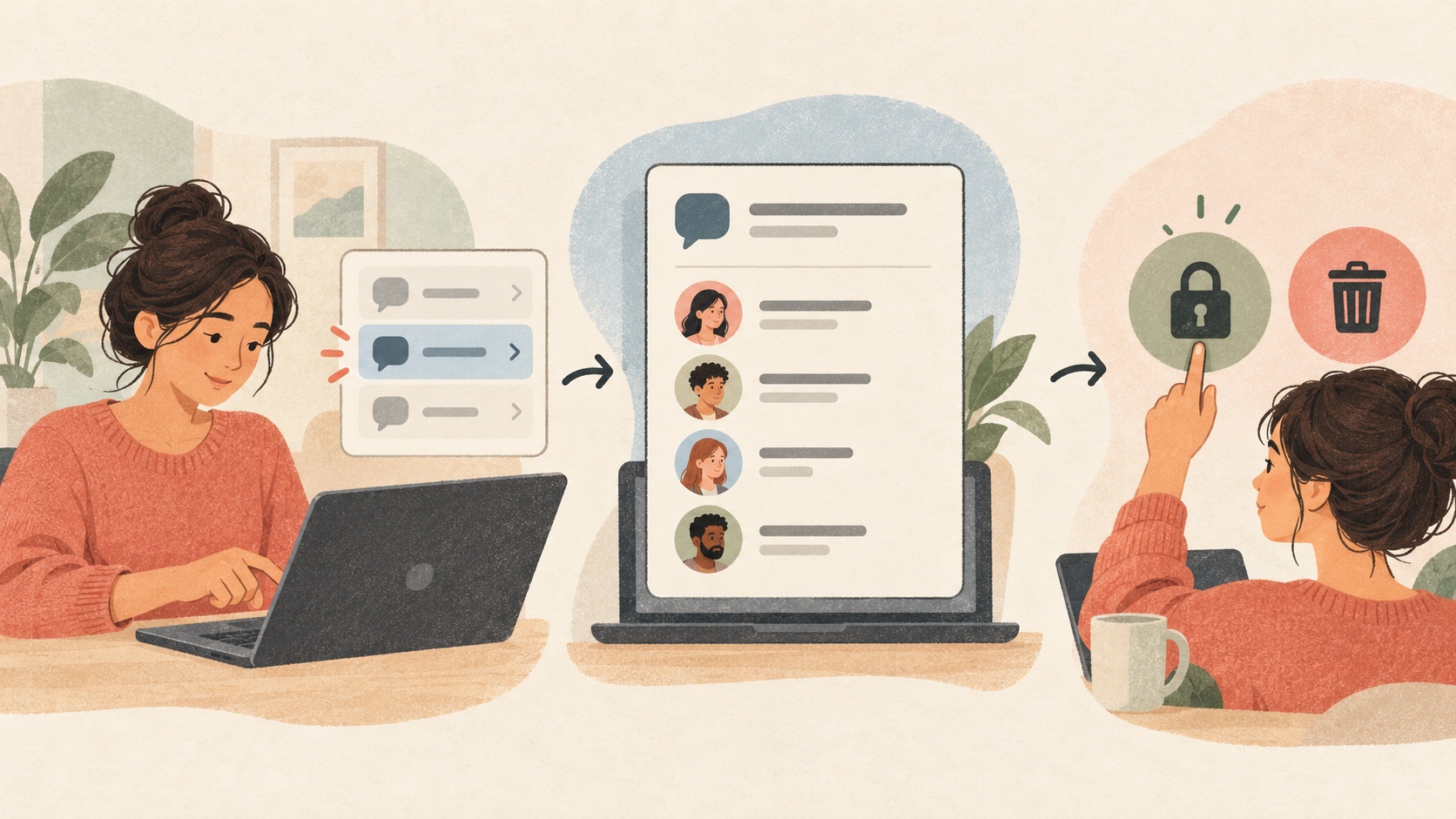
Illustration: choose a relevant file, check participant names and review the deletion controls before sharing.
Turn a finding into a useful next question
A report is most useful when it helps you choose a small, real-world next step. That might be to ask for a concrete time, name a practical need, or check whether you both understood an exchange the same way. It does not need to end with a verdict about the relationship.
Try a neutral question that names what you observed and leaves room for an answer:
I noticed we have talked about dinner twice but have not picked a day.
Would Thursday or Saturday work better, or should we leave it for another week?
For an uncertain emotional interpretation, lower the certainty of the wording:
I may be reading this wrong, but I was not sure how to understand that reply.
Did you mean you needed more time, or would you rather not make a plan?
And before you act on a strong claim, keep a short check for yourself:
Finding I am checking:
Messages that support it:
Context I may be missing:
What would change my mind:
One fair question or next step:
The point is not to turn every message into an investigation. Use a report to organize what you noticed, return to the original exchange, and decide whether a direct conversation would help. If the evidence is thin, let the interpretation stay tentative.
The product at whatbrandonthinks.org is designed around supported WhatsApp and iMessage exports, message evidence and a free preview. To see what a complete fictional result looks like, read the sample report. If you are ready to consider your own conversation, review the safety details and begin with the free preview.
You can also open the report workspace or return to the What Brandon Thinks homepage when you are ready to choose a supported chat.
Frequently asked questions
What is What Brandon Thinks?
It is a service that analyzes a supported WhatsApp or iMessage export and presents a structured report about communication patterns, with excerpts for important observations. This guide describes the service available at whatbrandonthinks.org.
Can What Brandon Thinks tell me what someone secretly thinks?
No. A chat can show words, timing and repeated behavior in the selected export. It cannot prove private intent or explain events that are missing from the conversation.
What do the confidence labels mean?
They show how strongly a finding is supported by the available chat evidence. Treat them as prompts to inspect the messages, not as probabilities that an interpretation is true.
Are the report’s message excerpts real?
Your personal report uses excerpts from the transcript you choose to upload, and important excerpts are checked against that file. The public sample report is clearly labeled fictional and does not use a customer conversation.
Can I read a What Brandon Thinks report before paying?
Yes. The free preview shows two sections from your own report before checkout, with no card required. The full sample report is also available without uploading a chat.
How long does What Brandon Thinks keep my chat?
The current safety and privacy details say transcripts are deleted within 48 hours if no report is created, or within seven days after the latest report if one is created. You can delete them earlier from your account.
Does What Brandon Thinks connect to WhatsApp or iMessage?
No inbox connection is needed. You choose a supported export and upload it. The WhatsApp guide and iMessage guide cover the accepted workflows.
Is What Brandon Thinks a substitute for therapy or professional advice?
No. It is for reflection and entertainment. It cannot diagnose someone or settle a medical, legal, employment or safety-critical question.