

Passive-Aggressive Letters: What They Say and How to Rewrite One
A passive-aggressive letter expresses frustration indirectly: it may sound polite on the surface while hinting that someone has behaved badly. A note about the dishes, an office fridge reminder, or a carefully chilly email can all fit. But one sentence cannot prove what its writer intended. This guide gives original fictional examples, explains the wording that makes each one indirect, and rewrites it as a request a reader can answer.
If you are trying to understand a repeated pattern in a conversation, explore our relationship chat guide. You can also start with a chat export, or return to What Brandon Thinks to see what the product can and cannot infer from messages.
What makes a letter passive-aggressive?
The phrase describes a mismatch between the surface message and the frustration underneath it. Instead of directly saying “Please do this,” a writer may rely on sarcasm, pointed politeness, vague blame, a backhanded compliment, or a reminder aimed at an unnamed person. The reader is left to infer both the complaint and the requested repair.
For example, “Some people have apparently forgotten how a sink works” criticizes an unnamed group but does not say who should do what, or when. “Please rinse your mug and leave the sink clear after breakfast” names a visible action. The second sentence may still feel awkward to send, but it gives the recipient a fair chance to understand and respond.
Indirect wording can be deliberate, habitual, humorous, or shaped by a situation where direct disagreement feels difficult. These are possibilities, not diagnoses. A note alone cannot tell you which explanation is true, and a single awkward sentence does not establish a person’s character. Focus first on the actual words, the practical problem, and whether it keeps happening.
Is a passive-aggressive letter different from a note or email?
People often use “letter” loosely for any written complaint, including a sticky note on a kettle, an email to a colleague, or a mailed message to a neighbor. The channel changes the level of formality; it does not decide whether the wording is passive-aggressive. A long letter can be direct and respectful. A three-word note can carry a sharp implication.
The useful distinction is between the format and the job the message is doing. Is it recording a request, giving information, setting a boundary, trying to shame someone, or asking them to guess what went wrong? If a real request is buried beneath a joke or a broad accusation, rewrite that part before choosing whether to send it by email, leave a note, or speak privately.
Five original passive-aggressive letter examples—and clearer rewrites
The examples below are fictional. They are written to illustrate common patterns in shared kitchens, workplaces, homes, and email; they are not quotations from real people or a test for identifying someone’s intent. Each one pairs a pointed version with a direct alternative.
1. The shared-kitchen sink note
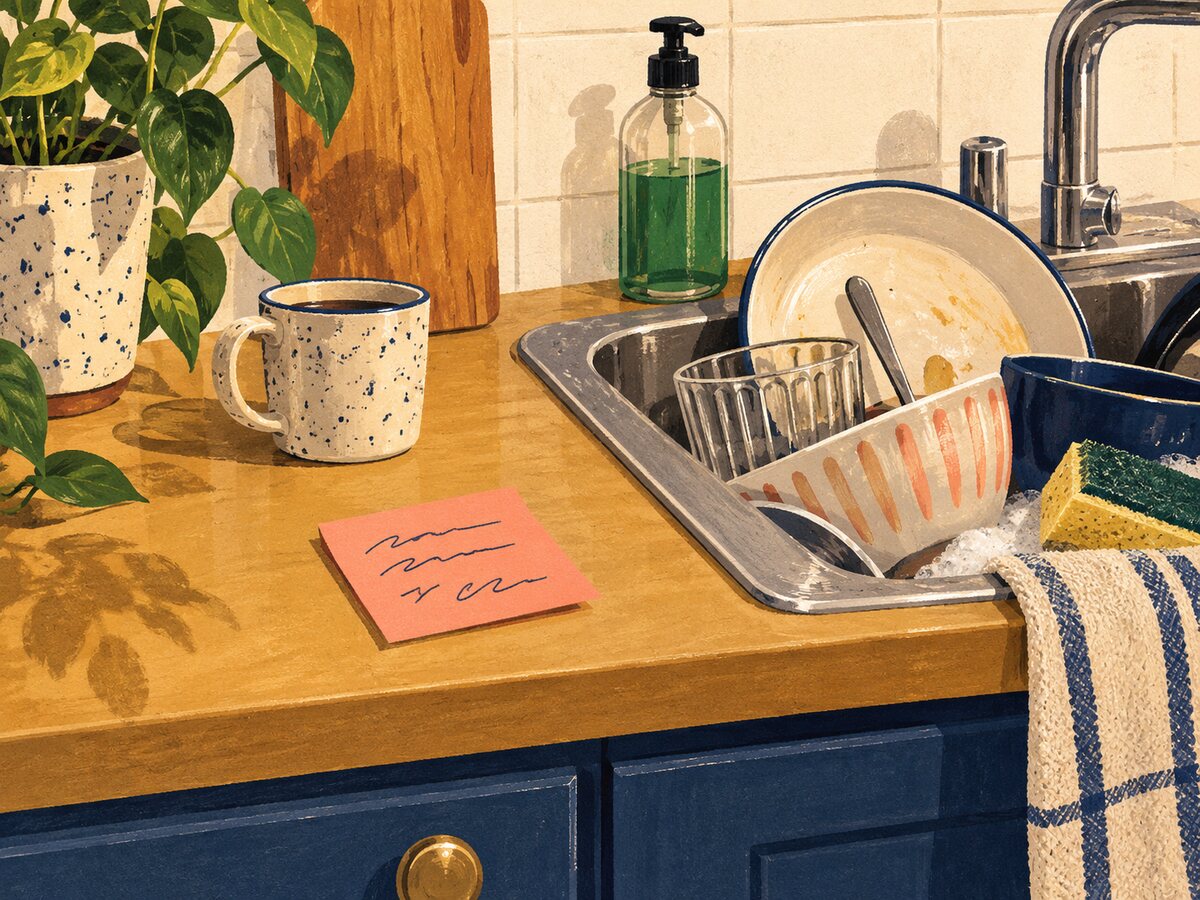
A fictional kitchen scene: the note is illustrative, not a real message.
To whoever thinks the sink fairy is working overtime: the dishes do not wash themselves. Some of us have jobs.
The joke points at a person without naming the dish or the next step. “Some of us” adds a comparison that can make the reader feel accused before they know what is being asked.
Clearer rewrite:
Could you rinse your mug and put it in the dishwasher after breakfast? The sink is full when I come in to cook. If the dishwasher is full, please leave the mug on the drying mat.
This version identifies the action, timing, practical effect, and a fallback. It does not need to prove that anyone is lazy or inconsiderate.
2. The office fridge letter

An imagined office break room, not a real workplace or coworker.
Friendly reminder: the fridge is not your personal storage unit. Amazing how many grown adults need this explained.
“Friendly reminder” says one thing while the insult says another. The note also addresses a whole room, so nobody knows which container or date matters.
Clearer rewrite:
Please label food with your name and the date. Facilities clears containers left past Friday, so add a label by Thursday afternoon if you want to keep yours.
If you are responsible for the space, state the rule and the actual deadline. If you are a coworker without authority to set one, ask the office manager what process the team uses instead of announcing a policy on everyone’s behalf.
3. The neighbor’s hallway note

A fictional shared-hallway scene; it does not depict an actual neighbor.
Some people apparently believe the hallway is an extension of their apartment. The rest of us enjoy being able to walk through it.
This letter states a preference but not the specific object, location, or requested change. “Some people” leaves the target implicit, which invites neighbors to trade guesses about who wrote it.
Clearer rewrite:
Could you move the two boxes beside apartment 4B’s door by 6 p.m. tomorrow? They narrow the shared walkway. If they are waiting for a pickup, please leave a note with the planned time.
Keep a request about shared space tied to what you can observe. If the issue involves building rules or an access concern, use the property manager’s established process rather than escalating with anonymous notes.
4. The family “helpful reminder”
Just leaving this here for the people who never notice when anything needs doing. You know who you are.
The writer may be asking for help, recognition, or a fairer split. The letter does not say which task is missing or how the family should divide it. The last line asks everyone to identify themselves as the problem.
Clearer rewrite:
I have handled dinner cleanup the last four nights and need to share it. Can you take dishes on Monday and Wednesday this week? If those days do not work, please suggest two that do.
This version names the writer’s need and proposes an arrangement someone can discuss. When the imbalance is ongoing, a short conversation about the routine is usually more useful than a new note after each difficult evening.
5. The icy “per my last email” reply

The laptop screen is illustrative; the email copy below is fictional.
Per my last email, which I already sent twice, I will wait for the information you were asked to provide.
The sentence contains a real status update, but the extra clause emphasizes the recipient’s failure. Depending on the context, “per my last email” may be neutral shorthand or a pointed rebuke; the phrase by itself does not settle that question.
Clearer rewrite:
I still need the final headcount to book the room. Could you send it by 2 p.m. today? If that deadline is not workable, tell me when you can confirm it and I will adjust the booking.
The rewrite keeps the history out of the request and makes the dependency visible. If you need a record of earlier attempts, list their dates plainly rather than adding a sarcastic aside.
A quick test: is the request hidden inside the complaint?
Before sending a note or letter, try a four-part edit. First, name one observable event. Second, describe its practical effect on you or the shared task. Third, ask for one concrete action. Fourth, add a reasonable time or a way to clarify. Then remove any line that guesses at the other person’s motive.
| Pointed draft | Observable issue | Answerable request |
|---|---|---|
| “Someone left this place a disaster again.” | The counter has crumbs after lunch. | “Please wipe the counter after lunch so it is clear for the next person.” |
| “Apparently labels are too much to ask.” | Two unlabeled containers are in the fridge. | “Please put your name and today’s date on containers by 4 p.m.” |
| “I guess quiet is a lost art.” | Music carries into the next apartment after 10 p.m. | “Could you lower the music after 10? I can hear it through the bedroom wall.” |

A visual reminder: move from a general judgment to an action the reader can take.
A 15-second visual recap: describe the action, make a request, and add context.
This edit is not a demand that you suppress anger or make every request sound cheerful. It separates the problem from a guess about who the other person is. A calm sentence can still set a firm limit; a friendly emoji cannot make a vague accusation clear.
How to write a firm letter without the passive-aggressive edge
Use this short template when a written request is appropriate:
Hi [name or group],

When [specific action or event] happens, [practical effect]. Could you [one concrete request] by [reasonable time]?

If that does not work, please [simple way to discuss another option].

Thanks,
[your name]
For instance, “When the shared table is left covered in boxes, I have nowhere to set groceries down. Could you move them by Sunday evening? If you are waiting for a delivery, let me know and we can choose another spot.” This is direct without claiming the other person deliberately blocked the table.
Step 1: Pick one event you can describe
Avoid “always,” “never,” “everyone,” and “you know what you did.” Those words turn one request into a debate about a person’s entire character. Write down the moment, object, or repeated task instead: the package is in the entryway, the schedule changed without notice, or the meeting still needs a decision.
If the problem is a recurring pattern, include two or three specific examples or talk about the pattern separately. A letter that lists every old grievance may be accurate to how you feel, but it makes the current request harder to find. Save the record for a conversation where both people can respond.
Step 2: Say what it changes for you
Describe the practical effect without turning it into a verdict. “The hallway is hard to pass with the boxes here” explains a constraint. “You clearly do not care whether anyone else can walk” claims to know a motive. The first gives the reader information; the second asks them to defend their character.
You can use an “I” sentence without making the whole message about your feelings: “I need the table clear before the delivery arrives,” or “I am not available to cover the Friday shift.” The point is to state your stake honestly, not to disguise a command as a feeling.
Step 3: Make the request small enough to answer
An answerable request names an action: rinse the cup, confirm the time, move the boxes, or reply with the final count. “Be more considerate” is a value judgment. “Please text me before changing our agreed pickup time” is a behavior the other person can consider.
Leave room for a real answer. A request is not clearer because it is more forceful, and a boundary is not the same as a threat. You may say what you will do if a limit is crossed, but describe your own next step rather than trying to control every choice the other person makes.
Step 4: Check timing and channel
A sticky note can work for a small, repeated household task. A private message or conversation is usually better when the topic is sensitive, personal, or likely to require context. A letter may be useful if you need to organize your thoughts or create a clear record, but written messages can also be forwarded, reread without tone, or misunderstood.
Wait until you can write the request without adding a line designed to sting. Then read it once as if you did not know the backstory. Would you understand what happened, what the writer needs, and when? Could you answer yes, no, or with a practical alternative? If not, revise the request rather than polishing the sarcasm.
How to respond when you receive a passive-aggressive letter
You do not need to decode every implication before responding. Start with the concrete issue, then decide whether a clarification is useful. For a kitchen note, “I’ll rinse my mug after breakfast. Did you mean the blue pan as well?” answers the task and asks a neutral question. You do not have to reply to “some people” as though you know exactly who the writer means.
For a work email, respond to the deadline or missing information: “I can send the headcount by 1 p.m. tomorrow. Is that early enough for the room booking?” If the tone is becoming a pattern that affects work, keep a factual record and address the communication process in a private, appropriate channel. Avoid circulating the message as entertainment; that can turn an unclear exchange into a larger conflict.
If you are unsure whether a sentence was meant as a joke or a criticism, ask once without accusation: “I’m not sure how to read that line. Is there something specific you’d like me to change?” A good-faith clarification gives the other person a chance to state the request directly. Their answer and future behavior will tell you more than guessing from one phrase.
Do not assume that you must manage another person’s tone at any cost. If the message includes threats, harassment, discriminatory language, or a pattern that makes you feel unsafe, preserve what you need and use the relevant support or reporting process. Do not confront someone alone if doing so could put you at risk.
When a note is the wrong tool
Choose another channel when the request involves an intimate conflict, an ongoing division of responsibilities, a power imbalance, or a boundary that needs a real discussion. An anonymous note can make a simple task easier to raise, but it can also make the target uncertain and the writer impossible to reach. That combination rarely helps people agree on what happens next.
For workplace questions, follow the process that applies in your organization. For a building or shared-property problem, use the established manager or maintenance channel. For family or relationship tension, a private conversation may give both people room to explain context. If a direct conversation does not feel safe, prioritize distance and appropriate outside support over writing the perfect letter.
What a passive-aggressive letter can—and cannot—tell you
Written wording can show indirect phrasing, sarcasm, a broad accusation, or an unclear request. It cannot establish, by itself, whether the writer intended to hurt you, whether the criticism is fair, or what they feel privately. The same words may land differently depending on a relationship, a deadline, a prior agreement, or a joke that is missing from the page.
Look for a repeated communication pattern before you draw a larger conclusion. Does the person state needs directly when asked? Do they clarify what they want? Does the same kind of note appear after a specific task, or across unrelated situations? These observations can help you choose a next step, but they still are not proof of a hidden motive.
If the pattern appears in a longer WhatsApp or iMessage exchange, our guides to friend and group conversations and family group chats explain what a transcript can show about recurring communication. A transcript can preserve context and repeated wording; it still cannot read someone’s mind. Review privacy and safety details before uploading any conversation. What Brandon Thinks supports WhatsApp and iMessage exports and ties observations to excerpts, but it does not analyze a standalone handwritten letter or prove private intent.
Frequently asked questions
What is a passive-aggressive letter?
It is a written message that signals frustration indirectly, often through sarcasm, pointed politeness, broad blame, or an implied complaint. The defining feature is the gap between the surface wording and the request the reader is expected to infer.
Are passive-aggressive letters always intentional?
No. People can use indirect wording deliberately, out of habit, under stress, or while trying to be funny. A note cannot establish which explanation applies. Ask about the specific request before treating it as proof of intent.
How can I tell if a letter is passive-aggressive or just direct?
Look at what the message asks you to do. A direct letter names the behavior or boundary and gives you a way to respond. A passive-aggressive one may hide the request behind a jab, a vague “someone,” or exaggerated politeness. Tone and relationship context still matter.
What should I say back to a passive-aggressive note?
Answer the practical issue and ask one calm question if the requested change is unclear. “I can move the boxes tonight; is the concern the walkway or delivery access?” is more useful than returning the sarcasm. You can also choose not to engage with a personal jab.
How do I write a complaint without sounding passive-aggressive?
Describe one observable action, name its practical effect, ask for one specific change, and include a reasonable time or follow-up. Remove rhetorical questions and lines that guess what the recipient cares about. The goal is clarity, not artificial sweetness.
Should I write a letter or talk to the person?
Use writing for a simple task, a boundary you want to state carefully, or a message that needs a record. Choose a private conversation when the issue needs back-and-forth or relationship context. If contact could be unsafe, use an appropriate support process instead.
Can one note prove someone is passive-aggressive?
No. You can describe what was written and how it affected you, but one message does not establish a stable trait or private motive. Repeated behavior gives you more context, yet interpretation should still leave room for what you do not know.
A clearer next step
A passive-aggressive letter often leaves the reader to infer the real request. You can make your own message more useful by naming one observable action, explaining its practical effect, and asking directly for a specific change. When you receive a pointed note, respond to the task you can verify and ask for clarification before assigning a motive.
For a question about an ongoing chat pattern, read more from What Brandon Thinks or start with a WhatsApp or iMessage export. The product can organize repeated messages and show excerpts in context. It cannot tell you with certainty what someone meant by a letter—or what they feel without saying it.